
Line and prep areas
Grease travels further than it looks: up equipment legs, down into the grout, and along the wall base behind the line. Cleaning has to reach under and behind units rather than only across the open floor.
Serving Corpus Christi, Texas & surrounding areas
Mon–Fri 8am–6pm · Sat 9am–2pm
Back of house and dining room
Cleaning for Corpus Christi kitchens and dining rooms, where grease moves differently than ordinary soil and an inspection can arrive without warning.
Grease behaves differently
The mop goes out at close and by the next afternoon the floor is tacky again. Grease does not sit on a surface the way dust does: it spreads under equipment where no mop reaches, it works into the grout, and it holds every grain of sand that walks in off the lot.
Restaurant cleaning in Corpus Christi has to treat the back of house and the front of house as two different jobs with two different standards. One is degreasing, drain care, and the quarry tile nobody sees under a line. The other is whatever a guest notices from the door.
Some of this sits on a longer cycle than a nightly close can carry. The grout under the line needs the machinery and dwell time that floor care services brings, and the build-up behind and beneath equipment is deep cleaning services work rather than a nightly task.
A nightly close
The kitchen and the dining room are written up separately, because the two fail in different ways.
Hood, duct, and exhaust cleaning sits outside this scope. That work belongs to a separate specialist trade, and we would rather state the boundary plainly in writing than leave it implied in an agreement you depend on.
What kitchen staff handle and what the cleaning scope handles is also written down. Closing duties and contracted work overlap in most kitchens, and that overlap is exactly where tasks quietly stop being done by anyone.
Rooms held to different standards
Back of house comes first below, then the rooms a guest sees. The two halves fail in different ways, which is why a scope treats them as separate documents.
Check AvailabilityGrease travels further than it looks: up equipment legs, down into the grout, and along the wall base behind the line. Cleaning has to reach under and behind units rather than only across the open floor.
Cold storage collects spills that set in place and go unnoticed until something gets moved. Shelving, floor corners, and door gaskets are scoped as their own stops instead of folding into a general kitchen line.
The dish area stays wet, and in Gulf humidity it never fully dries between shifts. Drains, splash zones, and the floor under the machine earn frequent attention because standing moisture over grease is where odor starts.
Guests form a view from the doorway, and sandy tracking off a coastal parking lot reaches the first few tables. Entry flooring, booth seams, and the bar rail carry most of what a guest actually touches.
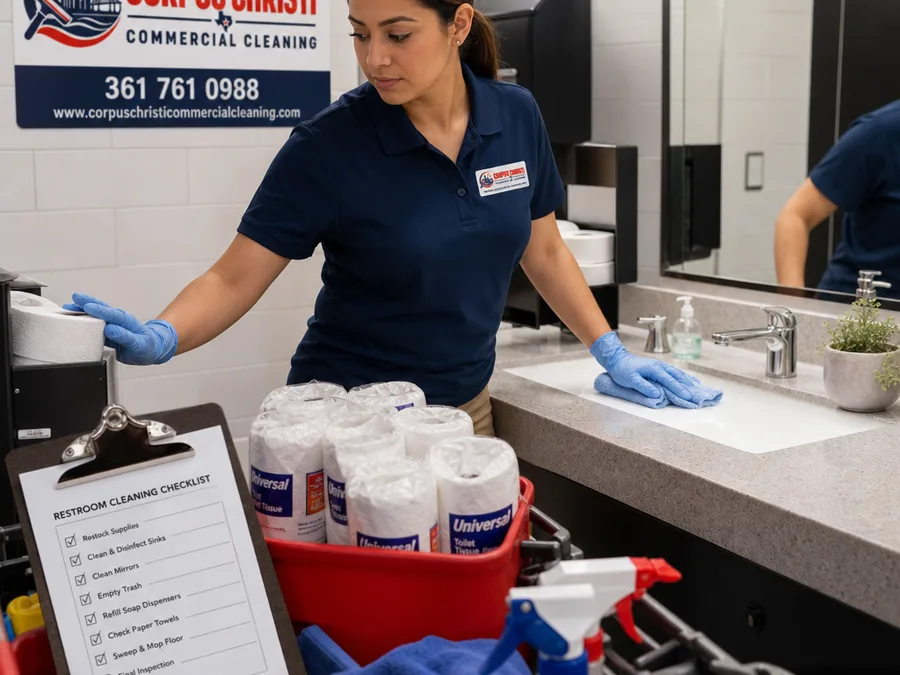
One restroom falling behind during a busy service undoes everything the kitchen got right. The scope covers fixtures plus the corridor outside, where carts and bus tubs scuff the wall base.
Before an inspection
An inspection does not announce itself, so readiness has to be a condition rather than a project. The places that get written up are predictable: grout under equipment, drain grates, the gap behind the line, the underside of prep tables, and the floor edge in a restroom. Naming those as stops on a stated cycle is what makes a surprise visit uneventful.
Services a kitchen needs
A nightly close holds the line, but parts of this need machinery and an empty building. Floor care services carries the quarry tile and grout cycle, which is what stops a kitchen floor reading gray no matter how often it gets mopped.
Build-up behind the line runs on a different interval again. Deep cleaning services covers the periodic pull-out, when equipment is moved, the wall base is cleared, and corners get reached that a nightly route has no hours for.
The agreement carrying all of it is commercial cleaning services, which settles access, keys, and who buys the consumables once instead of renegotiating each of those every time the scope shifts.
From close to standard
We walk a kitchen when it is dirty rather than when it is clean, because that is when the genuine problem areas show themselves. Closing duties get mapped on the same visit.
Back of house and front of house are written separately, each with its own tasks and frequency. Anything sitting outside the scope, hood work included, is named in that same document.
Early visits establish what the floor and grout actually need after however long they have gone. Catch-up work is identified apart from the nightly routine so neither hides the other.
A walk against the written scope follows, weighted toward the stops that fail an inspection first. Findings reach one named contact rather than whoever happens to be on shift.
Planning your budget
Kitchen square footage matters less here than equipment density: a tight line with many units takes longer per square foot than an open floor plan does. Frequency and how many hours the building sits closed set the remainder.
Starting condition is the other half. A floor carrying built-up grease in the grout needs catch-up work before a nightly routine can hold it, and that is scoped and priced apart from the recurring agreement.
Questions from operators
The hood question comes up first, so it is answered first. The rest deal with grease cycles, service hours, and where staff duties stop and a contract starts.
No. Hood, duct, and exhaust cleaning is a separate specialist trade and sits outside this scope, which we put in the agreement rather than leaving it implied. We clean the kitchen around that equipment: floors, drains, equipment exteriors, walls, and the areas underneath and behind the line.
Most kitchens need the floor addressed nightly and the grout on a longer cycle, because nightly mopping lifts what is loose and leaves what has already set. A line running fryers and a flat top loads a floor far faster than a prep-only kitchen, so the cycle gets set after a walk rather than from a rule.
Yes, and for most restaurants the only honest window is after close. Where a kitchen runs late and opens early, the scope is split so heavier work lands on the quietest night of the week and the rest fits whatever short window the building genuinely has.
It changes how long wet areas stay wet. The dish pit, the floor under the machine, and the mop sink corner do not dry between shifts here the way they would inland, and standing moisture sitting over a grease film is where odor begins. Drains and splash zones therefore get more attention than square footage alone would suggest.
Kitchen staff keep theirs, and the written scope names which tasks those are. Overlap between closing duties and contracted cleaning is the most common place for work to go undone, because each side assumes the other has it, so the split is set out area by area rather than described in general terms.
Usually yes, but as its own list. A dining room fails on what a guest sees, meaning entry flooring, booth seams, glass, and restrooms, while a kitchen fails on grease and drains, so a single frequency rarely suits both. Sandy tracking off a coastal lot also puts the entry on a shorter cycle than the rest of the room.
Tell us your closing routine and the hours the building is empty. We will walk the line, write the back and front of house scopes separately, and name whatever sits outside them.
Request a quote
Send the details and we will follow up to arrange a walkthrough and put a written scope together.
Other facilities we clean
Most of these buildings share a problem or two with a kitchen, and almost none of them share the whole list. The pages below cover what each one actually deals with.